

Baylor Interdisciplinary Core
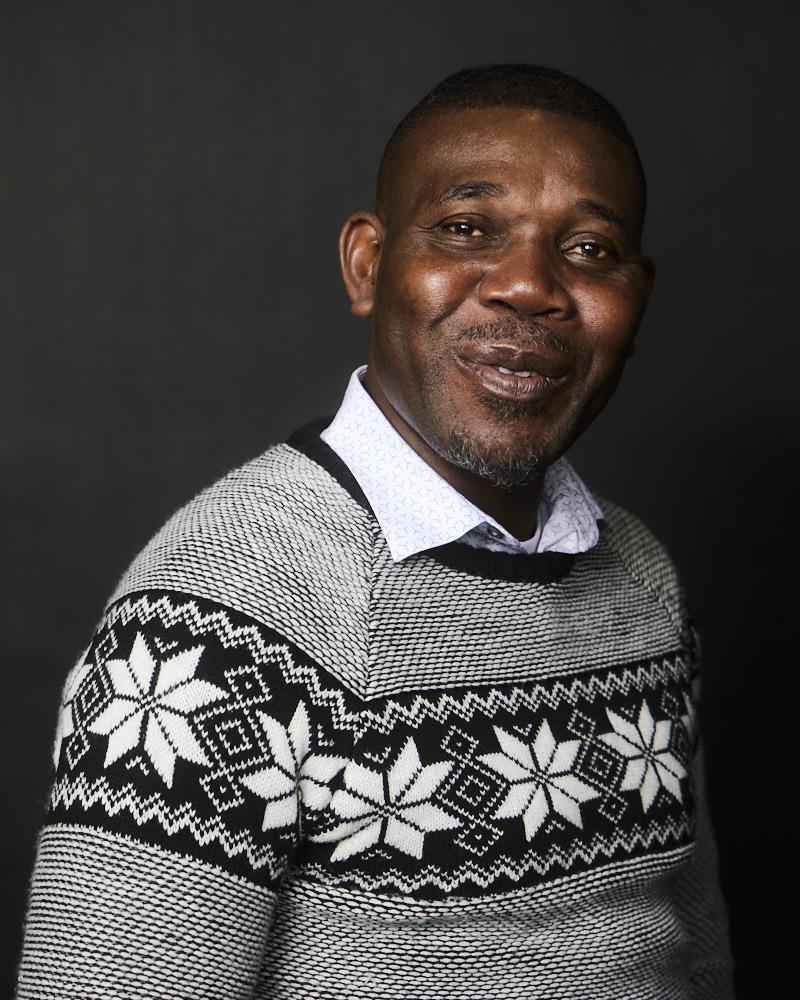
George Njung, Ph.D.
- Assistant Professor of African Studies in the BIC
Education
2016 Ph.D. in History, University of Michigan, Ann Arbor-MI
2014 Graduate Certificate in African Studies, University of Michigan, Ann Arbor-MI
2000 M.A. in History, University of Buea, Buea-Cameroon
1998 B.A. in History & Archaeological Sciences, University of Buea, Buea-Cameroon
Biography
Dr. George Njung is an Assistant Professor of African History in the Baylor Interdisciplinary Core Program and the Department of History. His research and teaching geographically straddles West and Central Anglophone and Francophone Africa. Thematically, he focuses on gendered and transnational histories of the First World War in Africa, colonialism, colonial gendered and sexual violence, war disability, and historical approaches to African migrant and refugee experiences. He is also interested in historical approaches to African development problems, the crisis of leadership and governance, social justice, and the varying micro and macro relationships and partnerships between Africa and the global north.
At BIC and in the history department, he teaches World Cultures II, III, and V, Hist 3315 – West Africa (to the 1960s), Hist 4353 – Religion and Politics in Africa, and Hist 1307 – World History Since 1500. He focuses predominantly on transnational, comparative, and gendered approaches to the teaching and learning of history. His emphasis on the role of women and gender in history hinges on the conviction that employing women and gender as a teaching frame is materially consequential to students’ world views and abilities to excel in a challenging and complex world.
His forthcoming monograph – Violent Encounters: Gender, Colonialism, and the First World War in Cameroon (Ohio University Press, 2026) – intervenes critically in Eurocentric historiography by demonstrating that, within the African context, no meaningful distinction existed between a “home front” and a “domestic front.” Rather, all gendered subjects participated actively and variously in the war’s frontlines. The study further challenges Eurocentric narratives that construe the violence of the war as anomalous or transgressive, contending instead that such violence was fundamentally transformative and constituted a continuum of the quotidian coercion and structural brutality inherent to colonial rule. Ultimately, the book positions the war as a pivotal moment in the history of trans-colonial and transnational mobility, forced migration, and processes of refugeeing. His subsequent book, Amputated Men: A Comparative Study of the Struggles of disabled WW1 ex-servicemen in British and French West Africa, will examine how the war reshaped gender identities in British and French West Africa and the differential treatment by the colonial governments of their war disabled.
Before joining Baylor in the fall of 2022, Dr. Njung was senior lecturer in history at the University of the Witwatersrand in South Africa from 2018-2022 where he taught, advised, and mentored undergraduate and graduate students.
Education
- 2016 Ph.D. in History, University of Michigan, Ann Arbor-MI
- 2014 Graduate Certificate in African Studies, University of Michigan, Ann Arbor MI
- 2000 M.A. in History, University of Buea, Buea-Cameroon
1998 B.A. in History & Archaeological Sciences, University of Buea, Buea-Cameroon
Selected publications as of December 2025
- ‘Playing Politics: A history of the Biafran child-refugee in Gabon and Côte d’Ivoire during the Nigerian Civil War, 1967-1970.’ Africa Today, 69:1-2 (Fall / Winter 2022):110-133.
- ‘Rethinking Refuge: Processes of Refuge Seeking – Special Issue Introduction.” Africa Today, 69:1-2 (Fall / Winter 2022):1-13. With Marcia Schenck.
- ‘Using legislation as a primary source to study political and electoral aspects of South Africa’s history in the 1960s.’ In Gale Researcher Guide. Marlborough: Adam Mathew Digital, 2022.
- ‘Refugee exchanges between Cameroon and Equatorial Guinea and their Socio-economic relevance, from the First World War to immediate post-independence.’ Canadian Journal of African Studies 55:3 (Fall 2021): 453-474.
- ‘Using posters for researching women’s struggles against apartheid in South Africa.’ In Research Methods Primary Sources. Marlborough: Adam Mathew Digital, 2021.
- ‘Amputated men, colonial bureaucracy, and masculinity in post-World War I colonial Nigeria.’ Journal of Social History 53:3 (Spring 2020): 620-643.
- ‘The British Cameroons Mandate Regime: The roots of the twenty-first-century political crisis in Cameroon.’ American Historical Review 124:5 (December 2019):1715-1722.
- ‘Victims of empire: WWI ex-servicemen and the colonial economy of wartime sacrifices in postwar British Nigeria.’ First World War Studies 10:1 (2019): 49-67.
Forthcoming:
- Violent Encounters: Gender, Colonialism, and the First World War in Cameroon, 1884-1916 (Ohio University Press, 2026).
- ‘A Pandemonium of a sort’: Military conscription in British and French West Africa during the First World War. In Conscription in the global twentieth century, edited by Amy J. Rutenberg. University Press of Kansas, 2026.
- War and peace: In The New Cambridge history of Britain, Vol. IV, edited by Lara Kriegel. Cambridge University Press, 2026.
- Amputated men: A comparative study of the struggles of disabled WW1 soldiers in British and French West Africa. 2028
Engines of Development: A Gendered History of Anglophone Cameroonian Immigrants and Refugees and the Local Economies of Greater Accra, Ghana. 2028.
- Contact Information
- George_Njung@baylor.edu
- Office Location
Draper 246.14
- Mailing Address
One Bear Place #97350, Waco, TX 76798
- George's Curriculum Vitae
- Curriculum Vitae