

Alumni Spotlight: Jerome Loughridge, B.A. 1995
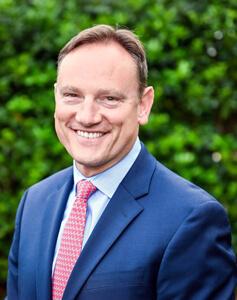
Jerome Loughridge, B.A. 1995
What year did you graduate from Baylor? What did you study?
I graduated from Baylor in 1995 as a University Scholar. I spent most of my time in the Tidwell Building under the instruction of the likes of Robert Reid and James Vardaman - venerable titans of teaching who left an indelible impact on my life - as well as (then) junior faculty like Scott Moore and Anne-Marie (Bowery) Shultz.
Tell us about your career and journey since graduating from Baylor.
I married my Baylor classmate, Tricia (Turman) Loughridge, immediately after graduation, and we commenced moving around the country. We lived in Chicago our first year out of school, where I worked for fellow Baylor alum, Mark Kimbell, at Children's Memorial Medical Center, prior to pursuing a Masters Degree in Public Policy at Harvard. After a couple of years in Tulsa, Oklahoma, we returned to Waco where I served as chief of staff to Baylor president Robert Sloan.
In 2003, I was selected as a White House Fellow, where I worked for Secretary of Defense Donald Rumsfeld on Iraqi reconstruction. Following a brief period in McKinney, Texas - where I worked with another fellow Baylor alum, David Brooks - Tricia and I settled back in my home state of Oklahoma, where I commenced a fifteen-year career in the oilfield service industry.
Most recently, I served in a volunteer capacity as the Secretary of Health & Mental Health for Oklahoma, appointed by the Governor and confirmed by the Oklahoma Senate in March of 2019. I led the State's early response to the Covid-19 crisis, including the development of our statewide surge plan, the acquisition of personal protective equipment, and the development of our testing regime. I retired from public service in July of this year.
How did your participation in the Honors Program influence your life and/or work since leaving, and Baylor?
There is not a day when the analytical rigor, the esteem for broad understanding, and the integration of faith and learning that was modeled for me at Baylor through the Honors Program does not impact my life and work. The nature of the Honors Program at the time (and, I believe, even more through the Honors College today) eschewed narrow specialization, esteeming instead the pursuit of knowledge as integrative and unified, reflecting the Scriptural admonition that "the Earth is the Lord's, and the fullness thereof." That worldview has helped shape my career, my public service, and the way in which we raise our boys.
Do you have any favorite memories from your time at Baylor?
I served as a member of the Baylor Chamber of Commerce while an undergraduate, and many of my fondest memories draw from my experience helping conduct events like Homecoming and Diadeloso. Much of the "muscle memory" I developed around serving others derived from my days as a Chamberman, and the relationships I formed in common service with pledge brothers and fellow members - Brady, James, Rob, and many others - persist as cherished treasures today.
Who was a mentor you had during your Baylor experience? How did their investment impact you?
Dr. James Vardaman took an interest in me as a Freshman, and I subsequently took every class I could from him - working as his grader for History of Western Civilization. I spent time with the inimitable Dr. Vardaman and his incredible wife and life partner, Elizabeth Vardaman, both in Waco and abroad in Europe. Much of how I view history - and the development of public policy, which I have been fortunate to participate in at some fairly high levels - came from Dr. Vardaman's tutelage. His expansive worldview, his commitment to rigorous reading and understanding and his native empathy helped form my character and shape my own approach to others. (He also helped me understand how anything less than my best was an unacceptable compromise - a lesson he illustrated with great aplomb one sunny Fall day in 1992 when I had missed the mark on an exam. It left an indelible impression...)
Do you have any advice for current students in the Honors College?
I have served the last several years on the Honors College Advisory Board and, from that vantage point, have been blessed to have a front-row seat to watch the development of the full and vibrant College community. Included in that maturation has been the growth of Dean Doug Henry into a world-class leader, the creation of living accommodations that truly foster a flourishing intellectual community, and the extension of the College into broad fields of inquiry and knowledge. My encouragement to students in the Honors College is this: make good use of the uncommon riches available through the remarkable faculty and classmates in the College. Take a course that doesn't "fit" in your plan. Join a study group on a topic that doesn't advance your degree program. Search the recommended reading list or syllabus from an Honors College professor outside your area of inquiry and read it... then ask if they might have time for coffee to discuss. Hackneyed though it may sound, this is the season in life where curiosity stands the greatest chance of satisfaction and intellectual mentors are most readily accessible.